Table of Contents
Executive Summary
The Al Fahidi Historical Neighbourhood, historically known as Al Bastakiya, represents the architectural conscience of Dubai. In a metropolis globally synonymous with futuristic hyper-modernity—defined by the Burj Khalifa, artificial archipelagos, and automated transit—this district offers a profound counter-narrative of adaptation, heritage, and resilience. Standing as the last remaining wind-tower quarter on the Arab side of the Gulf, Al Fahidi is not merely a tourist attraction but a surviving testament to the pre-oil commercial dynamism that laid the foundation for the modern emirate.
This report provides an exhaustive Al Fahidi Historical Neighbourhood guide, dissecting the district’s evolution from a late 19th-century merchant enclave to a contemporary arts and heritage sanctuary. Through a detailed Bastakiya Dubai walking tour itinerary, the analysis explores the intricate “secret doors”—both literal and metaphorical—that lead to hidden courtyards, specialized museums, and avant-garde galleries. It investigates the technical ingenuity of the barjeel (wind tower), the sociopolitical history of the district’s near-demolition and subsequent royal preservation, and the enduring aesthetic of Arabic calligraphy architecture. Furthermore, the report contextualizes Things to do in Old Dubai within the broader framework of sustainable cultural tourism, positioning Dubai heritage sites as critical assets in the city’s diversification strategy.
1. Introduction: The Palimpsest of Dubai Creek
To understand Al Fahidi, one must first understand the geo-economic landscape of the Dubai Creek (Khor Dubai). Before the discovery of oil in the 1960s, the Creek was the lifeblood of the city—a natural saltwater inlet that facilitated pearl diving and fishing, and served as a safe harbor for dhows trading with India, East Africa, and Persia. The Al Fahidi district, situated on the southern bank (Bur Dubai), emerged not as a humble fishing village but as a wealthy enclave of transnational commerce.
The urban fabric of Al Fahidi is a palimpsest—a manuscript on which the original writing has been effaced to make room for later writing but of which traces remain. The district preserves the footprint of the late 19th and early 20th centuries, a period characterized by the “free trade” policies of the Al Maktoum rulers that attracted merchants from across the region. Unlike the ephemeral Arish (palm-frond) settlements that housed the majority of the population, Al Fahidi was built to last, utilizing coral stone and gypsum to create permanent structures that signaled the permanence of the merchant class’s commitment to Dubai.
Today, walking through the high-walled alleyways (sikkas) of Al Fahidi is an act of time travel. It offers a sensory experience diametrically opposed to the glass-and-steel canyons of Sheikh Zayed Road. Here, silence is a heavy, tangible presence, broken only by the call to prayer or the rustle of a neem tree in a hidden courtyard. This report aims to unlock these spaces, guiding the reader through the wooden doors that guard the city’s history.
2. Historical Genesis and Preservation Dynamics
2.1 The Bastak Connection and Early Urbanization
The genesis of the Al Fahidi Historical Neighbourhood dates back to the 1890s.1 The district derives its former name, Bastakiya, from the town of Bastak in the Hormozgan province of southern Iran. In the late 19th century, affluent Sunni merchants from Bastak, known as Bastakis, migrated to Dubai, driven by increasing taxation and religious pressure in Persia and attracted by the liberal economic policies instituted by Sheikh Maktoum bin Hasher Al Maktoum in Dubai.2
These merchants brought with them not only their wealth, generated largely through the pearl and textile trades, but also their architectural vernacular. The Bastakis did not adopt the local building styles; rather, they imported and adapted the sophisticated urban planning of southern Persia to the Arabian coast. This resulted in a high-density, compact residential neighborhood comprising approximately 60 housing units.1 The urban morphology was deliberate: houses were clustered together to maximize shade, and narrow alleys were oriented to channel the prevailing breeze.3
The district quickly established itself as a locus of power and prestige. Its proximity to the Al Fahidi Fort—the seat of government and residence of the Ruler—underscored the symbiotic relationship between the ruling family and the merchant class. The grandeur of the houses, with their towering barjeels and intricate decorative stucco, served as a public ledger of the community’s economic vitality.4
2.2 The Crisis of Modernity: The 1970s and 80s
The discovery of oil and the subsequent formation of the United Arab Emirates in 1971 precipitated a rapid transformation of Dubai’s urban landscape. As the city expanded, the wealthy families of Al Fahidi began to relocate to the new, modern suburbs of Jumeirah and Umm Suqeim, seeking the comforts of air-conditioned villas and car-centric planning.3
By the late 1970s and early 1980s, Al Fahidi had fallen into disrepair. The once-grand merchant houses were subdivided and rented to low-income laborers or used as warehouses. In the rush to modernize, the district was viewed by urban planners as an obsolete relic, an impediment to the development of a modern commercial center in Bur Dubai. Consequently, in the 1980s, approximately half of the original neighborhood was demolished to make way for a new office complex, known today as the Ruler’s Court area.1 The remaining structures were slated for the bulldozer, marking a critical juncture in the history of Dubai heritage sites.
2.3 The Royal Intervention: A Turning Point
The survival of the remaining half of Al Fahidi is arguably one of the most significant events in Dubai’s cultural history, owed to a serendipitous alignment of advocacy and diplomacy. In 1989, British architect Rayner Otter, who had taken up residence in one of the dilapidated houses and begun renovating it, launched a campaign to save the district.5
Otter’s pivotal move was to write a letter to Prince Charles of the United Kingdom, who was scheduled to visit Dubai later that year. Prince Charles, a vocal proponent of traditional architecture and urbanism, expressed a desire to visit the historic quarter. Upon his arrival, he toured the area with Otter. Impressed by the climatic ingenuity and aesthetic value of the wind towers and courtyards, the Prince reportedly suggested to the Dubai authorities that the district was of unique global value and should be preserved.1
This royal endorsement catalyzed a shift in policy. The demolition orders were cancelled, and the municipality began to view the area not as a slum to be cleared, but as a heritage asset to be cherished. This marked the beginning of the transition from Bastakiya the residential quarter to Al Fahidi, the open-air museum.
2.4 The Restoration Era
In 2005, the Dubai Municipality launched a comprehensive restoration project under the supervision of Rashad Bukhash, an Emirati architect whose own ancestral home was in the district.2 The restoration was meticulous, adhering to traditional methods and materials. Modern cement, which traps moisture and damages coral stone, was removed and replaced with traditional gypsum and lime plasters.
The renaming of the district to the Al Fahidi Historical Neighbourhood was a strategic move to root the area more firmly in the local geography, linking it to the Al Fahidi Fort and the ruling Al Maktoum family’s history, while acknowledging the Bastaki origins.5 Today, the district stands as a pristine example of conservation, where the buildings have been adaptively reused as museums, galleries, and cultural centers, ensuring their physical survival through economic utility.
3. Architectural Anatomy: Engineering the Elements
The architecture of Al Fahidi is a direct response to the harsh desert climate and the social requirements of Islamic privacy. It is a functional architecture that achieved beauty through engineering.
3.1 The Barjeel: A Masterpiece of Passive Cooling
The most iconic feature of the Al Fahidi Historical Neighbourhood guide imagery is the barjeel, or wind tower. These structures are not merely decorative; they are sophisticated thermal regulation devices.
| Feature | Description | Mechanism |
| Structure | A square tower rising 5–15 meters above the roofline, open on all four sides. | Captures wind from any direction. |
| Internal X-Frame | Diagonal partitions inside the tower. | Forces the captured wind downwards into the room below. |
| Materiality | Constructed of coral stone and gypsum, reinforced with chandal (mangrove) or sandalwood poles. | Thermal mass keeps the structure cool; wood provides tensile strength. |
| Function | Passive cooling. | Creates a pressure differential that forces cool air down and pulls hot air up and out (chimney effect). |
The physics of the barjeel allows it to lower indoor temperatures by up to 10 degrees Celsius compared to the outside air.6 In the humid climate of the Gulf, this airflow was essential for survival before air conditioning. The number and size of the wind towers on a house were also status symbols; a house with three or four barjeels indicated a wealthy merchant who could afford the construction and maintenance of such complex systems.3
Contemporary art installations, such as the recycled cardboard wind tower at the Sikka Art and Design Festival, continue to explore this form, proving its relevance to modern discussions on sustainability and zero-energy cooling.7
3.2 The Sikka: The Urban Wind Tunnel
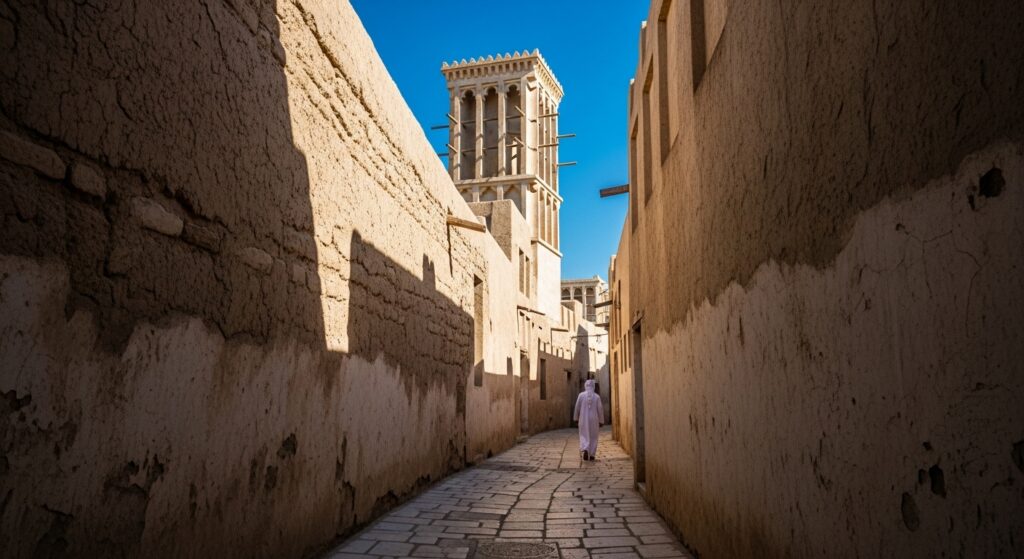
The urban plan of Al Fahidi is defined by the sikka—the narrow, winding alleyway. Unlike modern grid systems designed for automobiles, the sikkas were designed for pedestrians and pack animals. Their orientation is predominantly North-South to align with the prevailing winds from the Creek.3
The high walls of the houses cast the narrow alleys in deep shade for most of the day, preventing the ground from absorbing solar heat. This creates a microclimate within the sikkas that is significantly cooler than the open waterfront. The winding nature of the paths also served a social function: it broke the line of sight, ensuring privacy for the entrances of the homes and preventing dust storms from tunneling through the district with full force.8
3.3 The Secret Doors: Hierarchy and Privacy
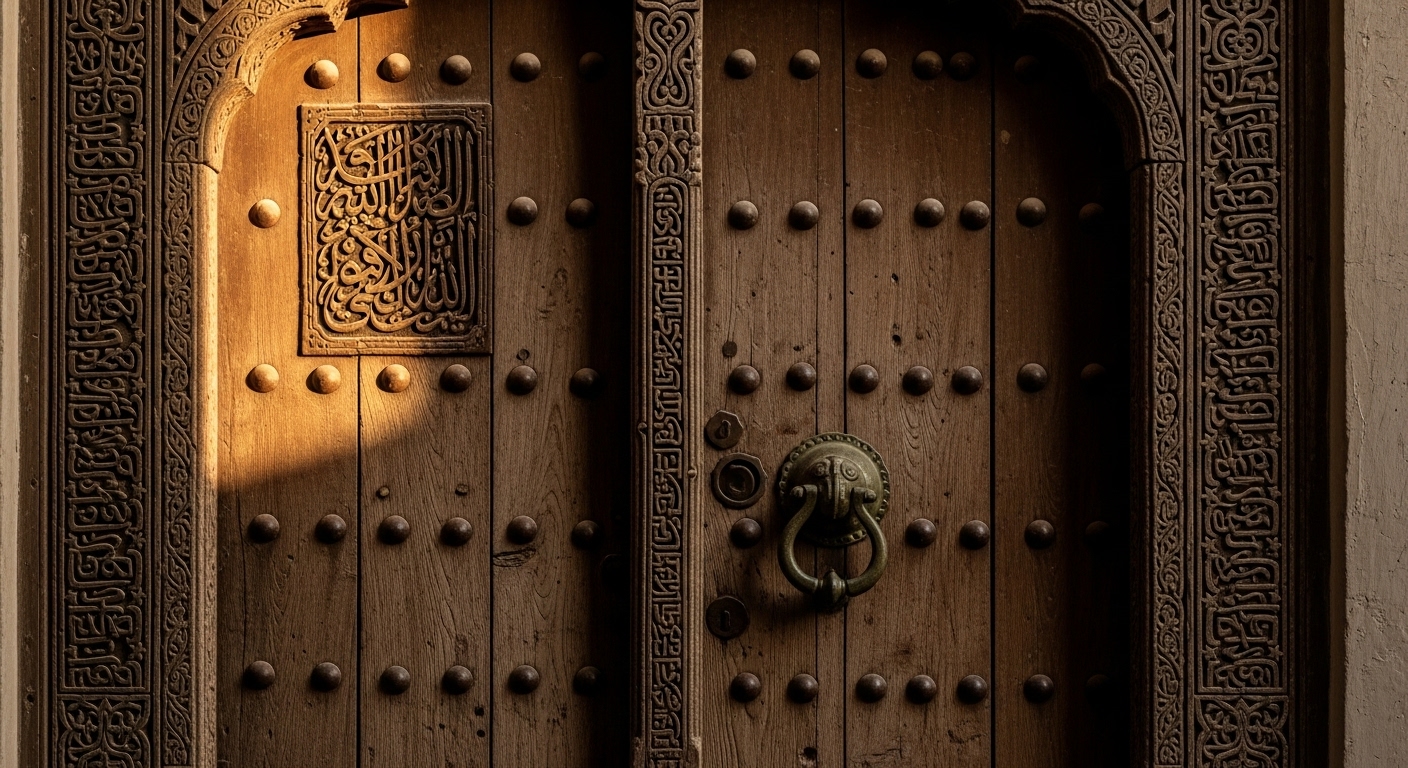
The title “The Secret Doors” alludes to the district’s distinctive wooden entrances, which serve as critical thresholds between the public realm of the sikka and the private sanctity of the courtyard house.
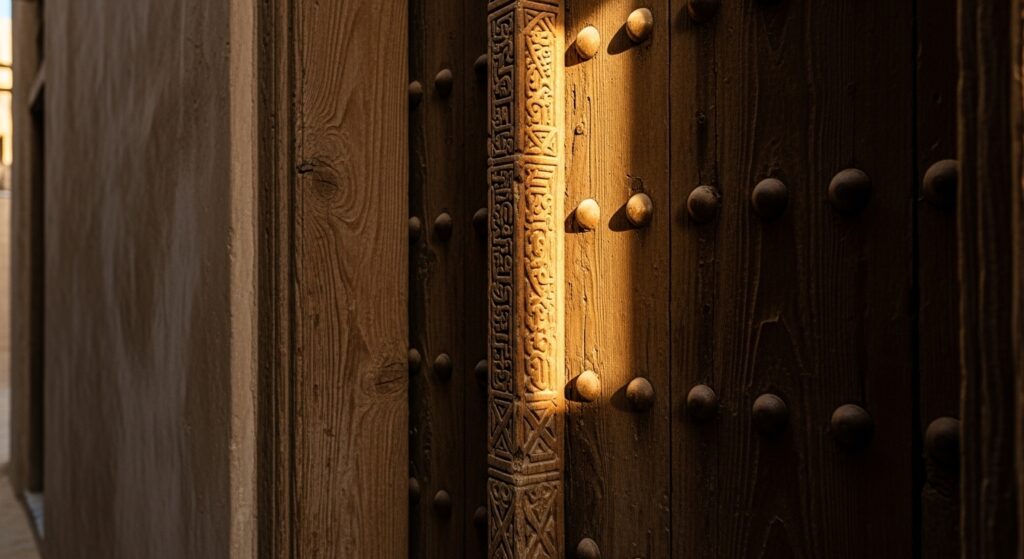
- Materiality: The doors are typically made of thick teak wood, imported from India or East Africa, as local timber was unsuitable for such heavy construction. They are often studded with iron or brass for durability and decoration.4
- The Al Farkha: Many large main gates feature a smaller, inset door known as Al Farkha (literally “the chick”). This allowed residents to enter and exit without opening the massive main gates, preserving the cool air inside and maintaining privacy.4
- The Blind Entrance: Upon entering a door in Al Fahidi, one typically faces a pun wall—a privacy screen that forces the visitor to turn 90 degrees before entering the courtyard. This architectural device ensures that a passerby in the street cannot see into the family’s private space when the door is opened.3
- Social Coding: The size and ornamentation of the door were direct indicators of social standing. Elaborately carved geometric or floral patterns (Arabesque) signified a household of high status, while simpler, smaller doors indicated more modest means.4
3.4 Construction Materials: Coral and Gypsum
The very fabric of Al Fahidi is born from the sea. The walls are constructed of fossilized coral stone cut from the reefs of the Creek. Coral is porous, giving it excellent insulation properties (low thermal conductivity). The stones were bound together with a mortar made of lime and crushed shells (sarooj).
The walls were then plastered with gypsum and often decorated with intricate geometric recesses. This layering created a breathable wall that could absorb moisture during the humid nights and release it during the day, further aiding in cooling.8
4. The Cultural Landscape: Art, Calligraphy, and Museums
Al Fahidi has metamorphosed from a residential district into a vibrant cultural district, often described as an open-air museum. This transformation is central to the Things to do in Old Dubai experience.
4.1 Arabic Calligraphy Architecture
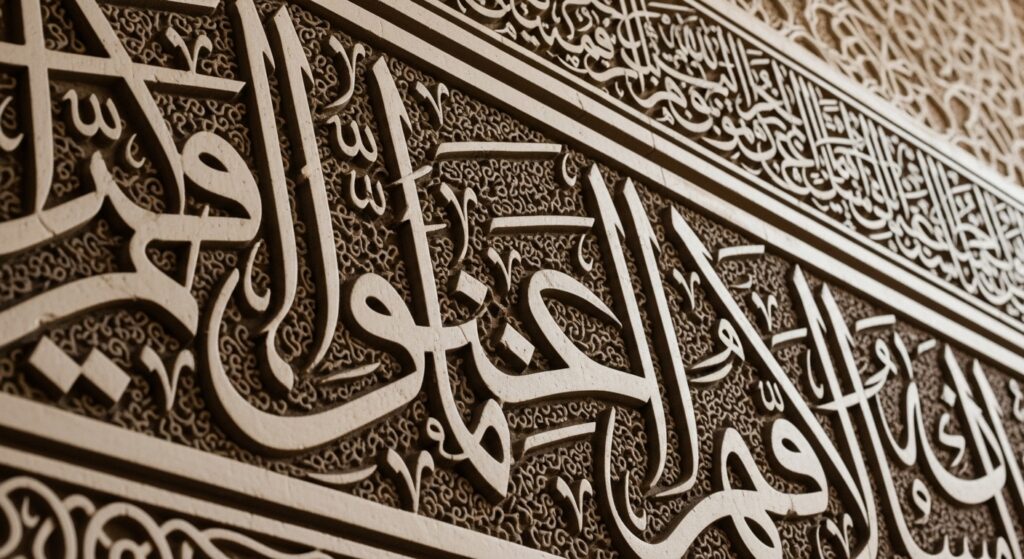
The aesthetic identity of Al Fahidi is intertwined with Arabic calligraphy architecture. Unlike the monumental scripts of grand mosques, calligraphy here is intimate. It appears on the gypsum panels above doorways, in the carved wooden lintels, and most prominently at Dar Al Khatt Al Arabi (The Calligraphy House).
Located on Al Mussalla Street, this institution is dedicated to the preservation of Arabic script. The building itself serves as a canvas, with calligraphy integrated into its exterior façade. Inside, visitors can observe master calligraphers at work, bridging the gap between the utilitarian architecture and the sacred art of the written word.11 During the Sikka Art and Design Festival, the alleyway walls often feature “Calligraffiti,” a fusion of traditional scripts and modern street art, turning the historic stones into a contemporary canvas.14
4.2 The Museum District Concept
Al Fahidi functions as a specialized “Museum District”.2 Rather than one large encyclopedic museum, the neighborhood hosts a constellation of niche institutions housed in restored homes.
- The Coffee Museum: This museum offers a deep dive into the anthropology of coffee. It explores the legend of Kaldi (the Ethiopian goatherd), the development of coffee in the Islamic world, and its global diffusion. Artifacts include 300-year-old coffee pots from Yemen and grinders from WWI.15 The sensory experience of smelling roasting beans and tasting traditional Emirati gahwa (spiced with cardamom and saffron) is integral to the visit.16
- The Coins Museum: Often missed by casual tourists, this museum houses over 470 rare coins from the era before the UAE Dirham. It displays coinage from the British Empire, India (the Indian Rupee was legal tender in Dubai), and the Ottoman Empire, offering a numismatic history of Dubai’s trade connections.13
- Municipality House: A pristine example of traditional administrative architecture, showcasing how the early local government operated within the vernacular style.17
5. Comprehensive Al Fahidi Historical Neighbourhood Guide: A Walking Itinerary
This section provides a structured, step-by-step Bastakiya Dubai walking tour. To fully appreciate the interplay of light and shadow on the coral walls, the optimal time to visit is early morning (08:00–10:00 AM) or late afternoon (04:00–06:00 PM).
5.1 Logistics and Preparation
- Arrival: The Al Fahidi Metro Station (Green Line) is the most convenient access point. From the station, it is a 10-minute walk to the district entrance.9
- Attire: Modest dress (shoulders and knees covered) is respectful and recommended, particularly if visiting the SMCCU or entering local mosques.
- Navigation: While maps are available, the joy of Al Fahidi lies in getting lost in the sikkas.
5.2 Zone 1: The Cultural Gateway (SMCCU)
Begin the tour at the Sheikh Mohammed Centre for Cultural Understanding (SMCCU), located in a traditional wind-tower house near the Creek.
- Significance: Operating under the motto “Open Doors, Open Minds,” the SMCCU is the primary interface for cultural exchange.
- Experience: Visitors should book a cultural meal (breakfast or lunch). These sessions are hosted by Emiratis who encourage guests to ask frank questions about local culture, dress, and religion, breaking down stereotypes in a relaxed majlis setting.8
- Architectural Note: Observe the large central courtyard, which functions as the lungs of the house.
5.3 Zone 2: The Artistic Labyrinth
From SMCCU, delve deeper into the network of sikkas.
- XVA Gallery & Art Hotel: Locate the unassuming entrance to the XVA Gallery. Founded in 2003 in the former home of the Seddiqi family, this space is often cited as “Dubai’s best-kept secret.” It features three distinct courtyards and preserved wind towers. The gallery specializes in contemporary art from the Arab world and Iran. The XVA Café, located in the central courtyard, offers a vegetarian menu—a modern twist in a traditional setting.9
- The Majlis Gallery: Proceed to the Majlis Gallery, Dubai’s oldest fine art gallery (est. 1989). The space retains the domestic feel of the original house, with art displayed in what were once living quarters.9
- Make Art Café: Search for the Make Art Café, housed within the Alserkal Cultural Foundation. The entrance is a “secret door”—a low, traditional wooden gate that forces you to stoop slightly before revealing a stunning, sun-drenched courtyard. This space is a favorite for creatives and offers a rooftop with views of the wind towers.24
5.4 Zone 3: The Niche Museums
Navigate towards the specialized museums.
- The Coffee Museum: Spend 45 minutes here. Ascend to the upper level to see the Majlis and the library. Do not miss the tasting session included with the nominal entry fee (approx. AED 10).16
- The Coins Museum: Visit this free museum to see the physical currency that facilitated the trade wealth of the district.17
- Dar Al Khatt: Stop to admire the exterior calligraphy and, if open, observe the workshops inside.13
5.5 Zone 4: The Creek Interface and Souks
Exit the quiet district towards the bustling Dubai Creek.
- Al Fahidi Fort (Dubai Museum): While currently closed for major renovations (reopening anticipated in 2025), the exterior of the 1787 fort—the oldest building in Dubai—is a mandatory stop. It has served as a palace, garrison, and prison.29
- Textile Souk: Walk west towards the Textile Souk (Old Souk). The wooden roof of the souk is a modern addition but respects the traditional aesthetic.
- Abra Ride: Conclude the Bastakiya Dubai walking tour by taking an Abra from the Bur Dubai station to the Deira side. The fare is AED 1 (cash only). This short journey provides a panoramic view of the wind towers from the water, contextualizing their orientation towards the Creek.16
6. Hidden Gems and Secret Spaces: An Insider’s View
Beyond the marked map locations, Al Fahidi rewards the curious explorer with hidden spaces that offer solitude and unique perspectives.
6.1 The Courtyard of Make Art Café
As mentioned, the Make Art Café is located in a heritage villa of the Alserkal Cultural Foundation. Its courtyard is one of the most serene spots in the city. The juxtaposition of the ancient coral walls with modern art installations and the smell of brewing coffee creates a unique atmosphere. It is a prime example of how heritage sites can be activated for modern use without compromising their integrity.24
6.2 Rooftop Vistas
Public access to rooftops is generally restricted to preserve the privacy of neighboring houses (a religious and social imperative). However, specific venues offer sanctioned access:
- Arabian Tea House Rooftop: Offers a view of the immediate streetscape and the canopy of trees.
- XVA Hotel Rooftop: Provides an intimate view of the wind towers up close, allowing for a detailed inspection of the wooden poles (chandal) and the internal X-frames.33
- Orient Guest House: Another location where the rooftop terrace offers a panoramic sweep of the district against the backdrop of the Creek.
6.3 Photography: Chasing the Light
For photographers, the “secret” is timing.
- Golden Hour: The hour after sunrise casts long shadows in the sikkas, highlighting the texture of the rough plaster.
- Door Details: Focus on the Al Farkha doors. The most photogenic doors are found in the quieter alleys behind the Sahara Gate entrance.35
- Calligraffiti Walls: Look for the murals from the latest Sikka Art Festival, which are often tucked away in cul-de-sacs.37
7. Socio-Economic Analysis: The Value of Heritage
The preservation of Al Fahidi is not merely an exercise in nostalgia; it is a strategic asset in Dubai’s tourism portfolio. As the city competes for global tourists, the “authenticity” of Dubai heritage sites becomes a high-value commodity.
7.1 The “Museumization” of Residence
It is crucial to note that Al Fahidi is no longer a residential neighborhood in the traditional sense. The original families have moved on. The district is now a curated cultural zone. While this “museumization” preserves the physical structures, it changes the social fabric. The “residents” today are artists, curators, and cafe owners. This shift is common in global heritage preservation (gentrification) but is managed here to ensure that the new occupants (galleries, museums) are culturally relevant.2
7.2 Al Seef vs. Al Fahidi: A Study in Contrast
Just east of Al Fahidi lies Al Seef, a modern development by Meraas that mimics the traditional architecture of the wind towers. While Al Seef provides modern amenities, underground parking, and polished retail experiences, it stands in stark contrast to the genuine historical substance of Al Fahidi. For the discerning traveler, the comparison is instructive: Al Seef is the “Disneyfied” version—clean, convenient, and commercially optimized—while Al Fahidi retains the irregularities, the silence, and the “dust of history” that constitutes true heritage.38
8. Dining and Lifestyle: The Taste of History
Dining in Al Fahidi is an extension of the cultural experience. The venues here are not just restaurants; they are interpretive centers for Emirati hospitality.
8.1 Arabian Tea House
Located at the entrance of the district, the Arabian Tea House is an institution. Set in a large courtyard with white rattan chairs, lace curtains, and turquoise benches, it evokes the relaxed atmosphere of a bygone era.
- Must-Try: The Breakfast Tray (Emirati breakfast with balaleet—sweet vermicelli with eggs—and varying cheeses) and the signature lime and mint juice.16
8.2 Camel Cuisine at Local House
The Local House restaurant claims to be the first in Dubai to serve camel burgers. While often viewed as a novelty, camel meat is a traditional protein in the Bedouin diet (though usually reserved for special occasions). Dining here offers a chance to taste this heritage ingredient in a modern format.38
8.3 Bastakiya Nights
For a high-end dining experience, Bastakiya Nights offers traditional Lebanese and Emirati cuisine in a spectacularly restored wind-tower house. The interior, with its illuminated niches and high ceilings, provides a glimpse into the grandeur of the wealthy merchant lifestyle.9
9. Future Trajectories: 2025 and Beyond
The narrative of Al Fahidi is still being written. The most significant upcoming development is the reopening of the Al Fahidi Fort (Dubai Museum), scheduled for 2025. The renovation aims to modernize the exhibits while preserving the historic fabric of the fort. This will likely reinvigorate the district, drawing a new wave of visitors and reinforcing Al Fahidi’s status as the primary historical anchor of the city.29
Furthermore, the continued success of the Sikka Art and Design Festival points to a future where Al Fahidi serves as the incubator for Dubai’s creative economy. By blending the ancient Arabic calligraphy architecture with digital art and modern design, the district bridges the gap between Dubai’s past and its future.17
10. Conclusion
The Al Fahidi Historical Neighbourhood is a testament to the complexity of Dubai’s identity. It is a place where the walls breathe, where the wind is engineered, and where the door to a house is a carefully coded message of status and privacy.
For the visitor, walking through Al Fahidi is an act of discovery. It requires slowing down to the pace of the pedestrian, tuning out the noise of the modern city, and engaging with the silence of the sikkas. Whether it is the taste of saffron coffee in a hidden museum, the sight of a contemporary sculpture in a century-old courtyard, or the simple feeling of a cool breeze descending from a barjeel, the district offers a profound connection to the human ingenuity that allowed life to flourish on this creek for centuries.
As the “Secret Doors” of Al Fahidi open to the world, they reveal that the true wealth of Dubai lies not just in its gold souks or its oil reserves, but in the enduring legacy of its heritage. The Al Fahidi Historical Neighbourhood guide is, ultimately, a map to the soul of the city.
11. Structured Data and Comparisons
Table 1: Comparison of Al Fahidi vs. Al Seef
| Feature | Al Fahidi Historical Neighbourhood | Al Seef (Heritage District) |
| Origin | 1890s (Restored) | 2017 (New Construction) |
| Authenticity | Genuine historical structures (Coral/Gypsum) | Replica/Pastiche (Concrete with rustic finish) |
| Atmosphere | Quiet, museum-like, narrow sikkas | Commercial, bustling, retail-focused |
| Key Tenants | Museums, Art Galleries, Cultural Centers | International brands, Restaurants, Hotels |
| Best For | History, Art, Photography, Silence | Dining, Shopping, Modern conveniences |
Table 2: Key Museums in Al Fahidi
| Museum | Focus | Key Artifacts/Features | Entry Fee (Approx) |
| Dubai Museum (Al Fahidi Fort) | General History of Dubai | Oldest building (1787), Dhows, Dioramas (Reopening 2025) | Currently Closed |
| Coffee Museum | History of Coffee | 300-year-old pots, Grinders, Roasting demos | AED 10 |
| Coins Museum | Numismatics | 470+ rare coins, British/Indian currency | Free |
| SMCCU | Cultural Understanding | Cultural Meals, Q&A sessions | Varies by activity |
| Dar Al Khatt | Calligraphy | Live workshops, Architectural calligraphy | Free |
Table 3: Architectural Elements and Terminology
| Term | Definition | Function/Significance |
| Barjeel | Wind Tower | Passive cooling; status symbol. |
| Sikka | Narrow Alleyway | Wind channeling; shade creation; privacy. |
| Al Farkha | Small inset door | Daily access without opening main gate; thermal control. |
| Chandal | Mangrove wood poles | Structural reinforcement for roofs; imported from East Africa. |
| Arish | Palm frond house | Traditional housing for lower classes (contrasts with masonry). |
| Sabat | Covered passage | A room bridging over an alleyway, providing shade below. |
As you wander through these narrow sikkas (alleyways), you will notice intricate calligraphy carved into the gypsum and wooden doors. These aren’t just decorations; they are often welcoming poems or verses.
While English is spoken everywhere in the city, the true depth of this heritage unlocks when you understand the words behind the art. This is why many expats start their journey by enrolling in Arabic Language Courses Dubai—not just to speak, but to read the history written on these very walls.
For more information, visit our website Dubai Culture..
Works cited
- Beloved Bastakiya A Hub of Art, Culture and History – Victor Magazine, accessed November 19, 2025, https://www.victormagazine.net/beloved-bastakiya-a-hub-of-art-culture-and-history/
- Breathing Life into Bastakiya and the History of Dubai, accessed November 19, 2025, https://sultanalqassemi.com/articles/breathing-life-into-bastakiya-and-the-history-of-dubai/
- Wind-towers and alleys of Al-Fahidi tell tales of a vibrant historical era in Dubai – Urbanitarian, accessed November 19, 2025, https://urbanitarian.com/urbanscapes_post?id=52
- Al Fahidi Booklet Design_ENG AK, accessed November 19, 2025, https://www.tourguidetraining.ae/pluginfile.php/1/block_exalib/item_file/5/Al%20Fahidi%20Booklet%20ENG.pdf
- Al Bastakiya – Wikipedia, accessed November 19, 2025, https://en.wikipedia.org/wiki/Al_Bastakiya
- Wind Towers of Dubai: A Unique Architectural Feature in Heritage Village, accessed November 19, 2025, https://fzhelitours.com/dubai-wind-towers/
- Dubai’s Wind Towers Are the City’s Traditional and Beautiful Way to Beat the Heat, accessed November 19, 2025, https://matadornetwork.com/read/dubais-wind-towers-citys-traditional-beautiful-way-beat-heat/
- Al Fahidi Historical Neighbourhood: Discover Old Dubai’s Cultural Heart, accessed November 19, 2025, https://rentradar.ae/blog/al-fahidi-historical-neighbourhood-discover-old-dubais-cultural-heart/
- Al Fahidi Historic District | Dubai Museums, Art & Cultural Spots, accessed November 19, 2025, https://tripscapetourism.com/al-fahidi-historic-district/
- Al Fahidi Historical Neighbourhood | Dubai Culture, accessed November 19, 2025, https://dubaiculture.gov.ae/en/attractions/heritage-sites/al-fahidi-historical-neighbourhood
- Arabic Calligraphy at Bur Dubai – YouTube, accessed November 19, 2025, https://m.youtube.com/shorts/nYSmPONtgLw
- A Guide to Al Fahidi Historical Neighborhood in Dubai: A Walk into Arab’s 18th Century | BringYou, accessed November 19, 2025, https://www.bring-you.info/en/al-fahidi-historical-neighborhood
- Al Fahidi Historical Neighbourhood Experience in Dubai 2024 | Traveller’s Choice, accessed November 19, 2025, https://mytravellerschoice.com/dubai/al-fahidi-historical-neighbourhood
- CALLIGRAFFITI at Al Fahidi Historical Neighbourhood, DUBAI – Local Guides Connect, accessed November 19, 2025, https://www.localguidesconnect.com/t/calligraffiti-at-al-fahidi-historical-neighbourhood-dubai/210220
- Coffee Museum – Dubai Culture, accessed November 19, 2025, https://dubaiculture.gov.ae/en/attractions/museums/coffee-museum
- A Guide to Old Dubai: What to Eat, See and Do! – Travel Lush, accessed November 19, 2025, https://travel-lush.com/old-dubai-travel-guide/
- Al Fahidi Historical Neighbourhood | Visit Dubai, accessed November 19, 2025, https://www.visitdubai.com/en/places-to-visit/al-fahidi-historical-neighbourhood
- Coins Museum Bur Dubai, Dubai, United Arab Emirates – Reviews, Ratings, Tips and Why You Should Go – Wanderlog, accessed November 19, 2025, https://wanderlog.com/place/details/554283/coins-museum-bur-dubai
- Al Fahidi Historical Neighbourhood – All You Need To Know – CuddlyNest, accessed November 19, 2025, https://www.cuddlynest.com/blog/al-fahidi-historical-neighbourhood/
- Walking in Dubai: Cultural Places to Visit, accessed November 19, 2025, https://www.visitdubai.com/en/articles/dubai-cultural-walking-tour
- XVA Gallery Art Hotel & Café | Visit Dubai, accessed November 19, 2025, https://www.visitdubai.com/en/places-to-visit/xva-gallery-art-hotel-cafe
- XVA Gallery: Born Free Ceramics – Art Dubai, accessed November 19, 2025, https://www.artdubai.ae/vipevents/visit-jameel-arts-centre-2-18-2-2-2-2-2/
- Best Hidden Gems of Dubai You Need to Discover in 2025 – DXB Properties, accessed November 19, 2025, https://dxbproperties.ae/blog/top-hidden-gems-in-dubai
- MAKE Art Cafe | Eat / Drink in Dubai – Urbanaut app, accessed November 19, 2025, https://urbanaut.app/spot/make-art-cafe
- MAKE Art Café in Dubai Approaches First Anniversary with New MAKE Expansions Ahead, accessed November 19, 2025, https://mid-east.info/make-art-cafe-in-dubai-approaches-first-anniversary-with-new-make-expansions-ahead/
- Alserkal Cultural Foundation, Dubai, United Arab Emirates – Reviews, Ratings, Tips and Why You Should Go – Wanderlog, accessed November 19, 2025, https://wanderlog.com/place/details/33763/alserkal-cultural-foundation
- Coffee Museum Dubai (2025) – Best of TikTok, Instagram & Reddit Travel Guide, accessed November 19, 2025, https://airial.travel/attractions/united-arab-emirates/dubai/coffee-museum-dubai-JCVMwUY4
- accessed November 19, 2025, https://www.airial.travel/attractions/united-arab-emirates/%D8%AF%D8%A8%D9%8A/coin-museum-al-fahidi-EDhCBeXh
- 1787 to now: Dubai’s oldest building – the story of Al Fahidi Fort – Gulf News, accessed November 19, 2025, https://gulfnews.com/uae/1787-to-now-dubais-oldest-building-the-story-of-al-fahidi-fort-1.500233205
- Al Fahidi Fort | Visit Dubai, accessed November 19, 2025, https://www.visitdubai.com/en/places-to-visit/dubai-museum
- The BEST Al Fahidi Neighborhood tours 2025 – FREE Cancellation | GetYourGuide, accessed November 19, 2025, https://www.getyourguide.com/al-fahidi-l178978/neighborhood-tours-tc21/
- Bastakiya’s unique art scene at Al Serkal Cultural Foundation, Dubai – pendown, accessed November 19, 2025, https://www.manjulikapramod.com/travel/bastakiyas-unique-art-scene-at-al-serkal-cultural-foundation-dubai/
- XVA Gallery Art Hotel & Cafe in Bastakiya, Old Dubai, accessed November 19, 2025, https://dubaitravelblog.com/xva-gallery-art-hotel-cafe-in-bastakiya-old-dubai/
- 24 Hours Like a Dubai Celebrity: Exclusive Access to Hidden Gems, accessed November 19, 2025, https://goldentravelsandtours.com/24-hours-like-a-dubai-celebrity-exclusive-access-to-hidden-gems/
- Wooden Door Al Fahidi Historical Neighbourhood Stock Photo 2684801473 – Shutterstock, accessed November 19, 2025, https://www.shutterstock.com/image-photo/wooden-door-al-fahidi-historical-neighbourhood-2684801473
- Al Fahidi Historic District Dubai (2025) – Best of TikTok, Instagram & Reddit Travel Guide, accessed November 19, 2025, https://airial.travel/attractions/united-arab-emirates/dubai/al-fahidi-historic-district-dubai-B9uPwXdF
- 740+ Al Fahidi Fort Stock Photos, Pictures & Royalty-Free Images – iStock, accessed November 19, 2025, https://www.istockphoto.com/photos/al-fahidi-fort
- Discover Al Fahidi: Dubai’s Hidden Heritage Gem You Must Explore 2025!, accessed November 19, 2025, https://estatemagazine.ae/discover-al-fahidi-dubais-hidden/
- Exploring Dubai’s Heritage: Al Seef & Al Fahidi Historic Districts – YouTube, accessed November 19, 2025, https://www.youtube.com/watch?v=xdz6MMFWWvc
- Al Fahidi Historical Neighbourhood: A Timeless Dubai Experience in 2025 – Go Kite Travel, accessed November 19, 2025, https://www.gokite.travel/al-fahidi-historical-neighbourhood/